Economy and competitiveness
The EU economy has been falling behind, stagnating at an average of 70% of U.S. GDP per capita for the past 30 years. This underperformance is fundamentally due to a lack of competitiveness caused by factors such as Single Market fragmentation, a high and growing regulatory burden and elevated prices of inputs like energy. If these factors are not addressed by targeted policy actions, a “slow death” of the European economy (as warned by the Draghi Report) is a real possibility.
Access to finance: a key competitiveness factor
Access to finance on reasonable terms is also crucial for the competitiveness of companies in Europe. Finance needs to be available through multiple channels in order both to provide stability and to meet the different financing needs of companies of all sizes, particularly SMEs. The same goes for an internationally competitive taxation framework: taxes that are either too high or too cumbersome for companies operating in the EU hinder the development of the EU economy and put it at a disadvantage in relation to its international competitors. Moreover, a key challenge for business is that they generally face considerably higher rates of taxation than in the US and China.
To ensure the EU’s economic resilience and competitiveness, the EU must complete the Banking and Capital Markets Union and ensure the full implementation of the new economic governance framework. The EU must also promote a stable and globally competitive tax policy framework which, through avoiding new regulatory burdens, reduces tax and legal uncertainties, and mitigates double taxation risks. The EU must also take an ambitious approach to the modernisation of the next Multiannual Financial Framework (MFF) to ensure that the EU budget is able to address the increased needs for investment.
Economy and competitiveness
The EU has stagnated at 70% of U.S. GDP per capita for over 30 years, while other countries have fared much better during the same period (as an example, China’s GDP per capita relative to that of the US increased tenfold). This underperformance is due fundamentally to lower long-term competitiveness gains, and EU competitiveness is disappointing because of the still fragmented state of its real and financial markets, a high and growing regulatory burden and elevated prices of inputs like energy – which are also driven by regulation – all of which limit EU companies’ ability to exploit marketable innovations and grow. If those hindering factors are not addressed by determined policy actions, a “slow death” of the European economy (as warned by the Draghi Report) is a real possibility.
Access to finance on reasonable terms is also a precondition for companies making the investment necessary to drive growth and maintain competitiveness. Finance needs to be available through multiple channels in order both to provide stability and to meet the different financing needs of companies of all sizes, notably SMEs. Likewise, access to risk-mitigating derivatives on reasonable terms is of strategic importance for the risk management of non-financial companies, they stabilise cash flows and enhance creditworthiness.
Contact

Lúcio Vinhas de Souza
The EU has been stagnating at 70% of the U.S. level of GDP per capita for over 30 years
%
82% of our members believe that the EU’s attractiveness for investment has deteriorated or remained unchanged over the past year
%
85% of our members believe that the new U.S. Administration’s deregulation agenda will divert investment from Europe
Watch our latest
6 March 2026
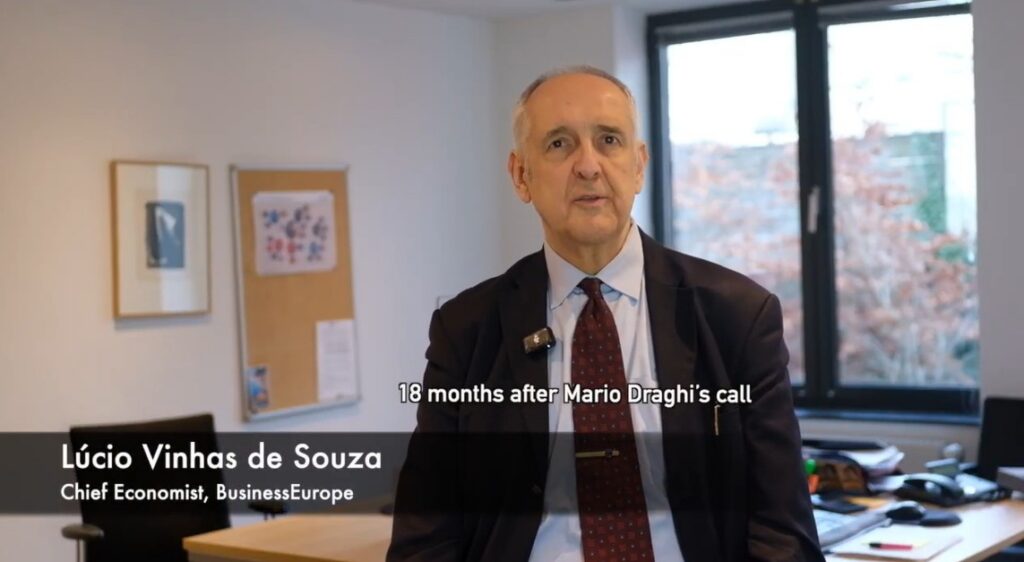
18 months after Mario Draghi’s call to strengthen Europe’s competitiveness, the key question is: are we delivering? Watch our Chief Economist Lúcio Vinhas de Souza address this and present the main findings of our latest Reform Barometer.