
In the run-up to the European elections in 2024, BusinessEurope called for a “REBOOT” in European policies, focussing on competitiveness and calling for targeted actions to tackle the structural weaknesses that are hampering companies’ efforts to deliver for the European economy and the people.
Since the beginning of the new legislative cycle, the situation for European companies has changed dramatically. Geopolitical tensions are growing, and security threats are rising, while economic headwinds become stronger – adding to the competitive pressure on European businesses of all sizes. In today’s evolving environment, determined and future-oriented action by policymakers is more urgent than ever to strengthen Europe’s competitiveness and security as a foundation of prosperity and resilience.
European businesses acknowledge the new commitment of European policy makers to boost competitiveness and to reduce regulatory burden. However, companies on the ground do not yet feel relief. The high energy cost gap compared to major competitors remains a key issue. High levels of complex legislation continue to stifle investment and innovation. Barriers in our Single Market still hamper the growth and cross-border operations of companies of all sizes, and in particular of SMEs. In the meantime, international relations continue to deteriorate, the technology race intensifies, and labour market challenges continue to increase.
To put the European economy back on track, unity and a rapid substantive change of course are needed. The Letta and Draghi reports set out the right direction of travel. Now, we count on policy makers in the European institutions and in the Member States, to join forces and swiftly turn ambitions into tangible results. Europe’s economic success is everyone’s business and the precondition for strengthening Europe’s position in the world. This is why BusinessEurope calls for swift delivery across five areas where companies urgently need to see improvements in 2026.
Reduce regulatory burden in a deepened Single Market

Ambition initiated - What has been proposed so far?
- Forward-looking initiatives in the Single Market Strategy that remove regulatory barriers and facilitate doing business in Europe, such as the announced 28th regime and the harmonisation of authorisations and certification schemes for service providers are positive.
- The renewed focus on competitiveness and on the reduction of regulatory burdens is an important change of course. BusinessEurope strongly supports the priorities set out in the Competitiveness Compass and the accompanying simplification agenda, including the Omnibus initiatives.
- If well implemented, Omnibus I, the Environmental Omnibus and the Digital Omnibus will cut burdens on companies and can provide a model for other omnibus initiatives.
Progress pending - What is still missing?
Companies still encounter severe obstacles and barriers in the Single Market on a daily basis when selling products, offering services, scaling innovations or expanding into another Member State. For example, administrative barriers when setting up and operating a company across borders limit growth potential. Resolute actions to remove remaining regulatory barriers to the Single Market are needed and would generate an estimated economic benefit of more than €600 billion per year by 2032 and help close the innovation gap with the US and China.
According to an analysis of the Danish Presidency, the cost of regulation that has been approved or is still under negotiation, but has not yet been implemented is estimated to at least €71 billion annually for companies. Hence, even in the most optimistic scenario, EU business will most likely face higher regulatory burden in 2029 compared to now. Effective reduction of regulatory burden goes far beyond reporting requirements. To come anywhere near the promised regulatory burden reduction by at least 25% for all companies and 35% for SMEs, more needs to be done, also considering other innovative solutions and alternative procedures. Now is the time to review, reduce and restrain - with a clear focus on making rules simpler, more efficient and effective, while maintaining policy objectives, relevant standards and the integrity of the Single Market.
Action required - What steps need to be taken in 2026?
- Implement the Single Market Strategy with an ambitious roadmap and clear KPIs to 2028, starting with the removal of the ‘terrible ten’ barriers by the end of 2027.
- Deliver a 28th regime that effectively helps companies to establish, operate and grow more easily in the internal market and avoid them scaling elsewhere.
- Remove persisting regulatory barriers to cross-border trade, investment, labour mobility and provision of services in the Single Market, and prevent new fragmentation at EU and national level, including measures for regions with geographic challenges where necessary. For example, by removing withholding taxes on cross-border investment, digitising notifications, screening and harmonising permitting, licensing and authorisation schemes, and prioritising the greatest potential in industryrelevant services such as industrial installation, maintenance and logistics.
- Urgently complete the announced Omnibus packages and add a continuous stream of additional burden reduction measures, taking into account the almost 140 concrete proposals outlined in BusinessEurope’s Omnibook, to significantly reduce regulatory burden and compliance costs for companies. This needs to be complemented by equally ambitious programmes at Member State level and application of the Better Regulation principles.
- Swiftly accelerate industrial permitting procedures in a way that companies on the ground feel a difference, building on the proposed improvements in the Environmental Omnibus with regards to the environmental assessment.
Graph - Administrative burden reduction target 25%

Bring down energy prices and create a business case for decarbonisation

Ambition initiated - What has been proposed so far?
- The Clean Industrial Deal and Affordable Energy Action Plan in 2025 mark a change of course and rightly focus on the most pressing challenges such as driving down energy prices or accelerating permits. However, up until now, the Affordable Energy Action Plan has not led to the intended goal of internationally competitive energy prices.
- The adoption of the CBAM simplification package is a positive step, as is the recognition of the need to address the issue of export carbon leakage, circumvention and impact on downstream users.
- The announced Industrial Accelerator Act should bring forward helpful measures to stimulate demand for low-carbon technologies and products.
- The Clean Industry State Aid Framework (CISAF) was adopted and is already being used. It acknowledges the need to create clearer opportunities to foster investments and the need to reduce risks in private investments.
- The Grids Package rightly sees grids being recognised as a matter of overriding public interest given their critical role in the energy transition.
Progress pending - What is still missing?
The enabling conditions and incentives to create a viable business case for decarbonisation are still largely missing. The EU has yet to put in place effective short-term measures to lower energy costs and close the related cost competitiveness gap faced by European companies compared to their global competitors. Progress towards the creation of lead markets and of a true Energy Union remains incomplete, with fragmented markets and insufficient cross-border integration limiting efficiency and affordability. Moreover, EU climate and energy policies continue to lack a genuinely technology-neutral approach. For example, state aid thresholds still differentiate between technologies, making it harder for industries to invest in the technologies needed to achieve Europe’s climate neutrality targets.
Action required - What steps need to be taken in 2026?
- Reinforce targeted measures to reduce energy prices in the short term, while preserving the level playing field within the internal market. Improve the long-term contracting framework with instruments like Power Purchase Agreements (PPAs) and Contracts for Difference (CFDs). Reduce overall system costs like energy taxes or network charges.
- Advance further initiatives to integrate EU energy markets to narrow the energy cost competitiveness gap, through balancing interconnectors deployment with responsibilities for individual Member States to build electricity systems that contribute to wider system benefits.
- Boost the arsenal of carbon leakage measures by swiftly adopting an effective CBAM export solution, postponing the phase out of free allowances for CBAM sectors if the mechanism proves insufficient, and reconsidering the planned phase-out of free allowances for non-CBAM sectors in the upcoming ETS reform.
- Introduce flexibilities to address residual emissions which will remain in hard-to-abate sectors after 2040, for example by adjusting the Linear Reduction Factor (LRF), to avoid the “ETS endgame” in 2040.
- Ensure that the revenues from ETS and CBAM are fully used to support businesses in their decarbonisation efforts.
Graph - Industrial electricity prices in the EU-27, USA, UK, Japan, Canada and South Korea

Mitigate geopolitical risk, diversify and secure market access

Ambition initiated - What has been proposed so far?
- The EU-U.S. Joint Framework Agreement falls short of our initial expectations. However, it still brings a degree of much-needed stability and predictability for companies.
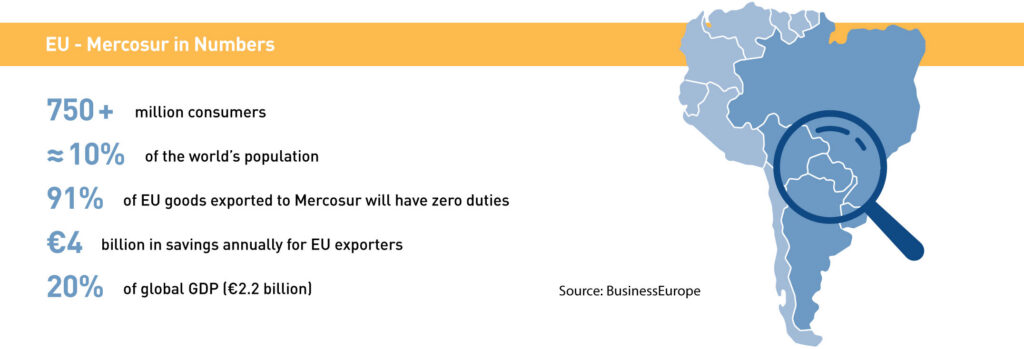
- Efforts undertaken to diversify the bilateral trade agenda with the signature of the Mercosur agreement and the conclusion of negotiations with Indonesia and India, along with the modernisation of the Mexico agreement are a necessity and need to be intensified.
- New forms of engagement with third countries, such as the Pact for the Mediterranean, the Clean Trade and Investment Partnership with South Africa, the Digital Trade Agreement with Singapore and ongoing negotiations with South Korea are important additions.
- Concerning Economic Security, the revised FDI screening Regulation is a step forward. The Commission’ s recent Economic Security Package goes in the right direction, when it comes to the comprehensive analytical approach, promoting a European approach and closer engagement with business, while some aspects still need improvement to ensure the right balance between security and an open economic approach.
Progress pending - What is still missing?
While the European Commission has taken steps towards a more harmonised approach to economic security with the Economic Security Communication, these proposals still need to be translated into concrete action. All EU measures regarding economic security must take into account the effects on EU economic competitiveness. The EU still faces the challenge of securing access to critical raw materials, leaving companies exposed to supply risks that continue to undermine industrial resilience and strategic autonomy. Finally, there is a pressing need to recalibrate Europe’s strategic priorities in its relations with the US and China.
Action required - What steps need to be taken in 2026?
- Make the necessary efforts to maintain a stable relationship with the US while firmly defending the European interests in a coordinated and united way in case they are undermined.
- Implement the EU-U.S. Joint Framework agreement and find solutions to outstanding issues, particularly those regarding Section 232 tariffs on steel and aluminium, including the growing list of derivatives. Furthermore, intensify engagement to ensure tariff stability and further liberalisation.
- Swiftly ratify and implement pending trade agreements, such as those with Mercosur, India, Mexico and Indonesia to strengthen Europe’s global economic ties.
- Accelerate ongoing negotiations with new partners, such as the ASEAN countries (e.g. Thailand, Malaysia, Philippines), foster closer ties with existing economic partners in our neighbourhood, such as the UK and Türkiye and ensure the integrity of existing supply chains with EEA/EFTA partners.
- Implement a derisking agenda vis-à-vis China to address market distortions, state-induced overcapacity and access to critical raw materials while maintaining engagement and dialogue.
- Reinforcing the economic relationship with Africa by revising existing trade and investment frameworks and by making sure that the Global Gateway delivers more private sector investment in the region, in close cooperation with business.
- Conclude the revision of the Union Customs Code by prioritising support and realistic timelines to minimise administrative burdens and trade disruptions, and by urgently tackling the issue of small parcels.
- Align more with the CPTPP countries, including the option to fully join the bloc, to foster the relationship with like-minded partners.
- Ensure the effective implementation of the RESourceEU Action Plan to accelerate and amplify efforts to secure the EU’s supply of critical raw materials.
Graph - EU-Mercosur in Numbers
Boost investments and innovation to regain technological leadership

Ambition initiated - What has been proposed so far?
- We acknowledge the ambitious MFF proposal to link research and innovation with other relevant aspects of competitiveness, particularly in the new European Competitiveness Fund and through an increased funding for the 10th Framework Programme for Research and Innovation (Horizon Europe).
- Measures announced in the Commission’s Savings and Investment Union (SIU) Communication, such as the blueprint for Savings and Investment Accounts, are a positive step forward. Measures to revive the EU Securitisation Framework and to boost equity investments by insurers and banks are also positive.
Progress pending - What is still missing?
Europe must close its investment gap and put the right framework conditions in place to attract private investments, develop new ideas and commercialise them in Europe. Moreover, the capital markets within the EU need to be developed and strengthened to remove obstacles for companies to scale.
80% of European venture capital is invested elsewhere. Europe lacks an innovation mindset. A risk-averse regulatory approach is limiting Europe’s ability to develop and invest in new technologies and ultimately the ability to regain technological leadership. Innovation cannot occur without accepting a certain level of managed risk.
Action required - What steps need to be taken in 2026?
- Ensure in the negotiations that the next MFF provides conditions that incentivise private investments. Maintain the proposed increase in budgetary support for the European Competitiveness Fund (ECF), flagship programmes and instruments such as Connecting Europe Facility, Global Europe and InvestEU, without adding to the already comparably high tax burden on businesses.
- Strengthen the involvement of private sector in the design and implementation of cohesion policy, to improve its impact and ensure cohesion policy is adequately funded under the next MFF.
- Further increase the budget for Horizon Europe beyond the level in the MFF proposal, in line with the Draghi report, to leverage private investments in research and innovation. Pillar 2 and in particular public-private partnerships must be at the core of the new programme, with an increased budget share and well-coordinated with the ECF and the other pillars of Horizon Europe.
- Swiftly complete the Savings and Investment Union by implementing agreed measures that improve access to capital markets, such as the Listing Package, to make equity and bond financing more attractive and simplify national listing rules.
- Encourage investments by institutional investors in long-term risk capital by addressing barriers to equity investment, for instance trough prudential rules. This is pivotal for supporting venture capital and private equity industry as an essential source of risk finance and expertise for innovative companies.
- Improve tax systems to better support equity-financed investment by introducing targeted tax allowances for corporate equity to support resilient, equity-financed investment and ensure financing neutrality across the Single Market.
- Reassess the EU’s Minimum Tax Directive, with an immediate focus on simplification and workability, ensuring alignment with global Pillar 2 implementation and rapidly delivering targeted relief and simplification measures to reduce compliance burdens and safeguard investment.
Graph - Gross domestic expenditure on R&D, 2013-2023

Boost employment and skills

Ambition initiated - What has been proposed so far?
- The Union of Skills and its STEM Education Strategic Plan is a positive step, which needs to be flanked by a change of approach in EU social policy.
- The signature of the Social Dialogue Pact 2025 by President von der Leyen showed the willingness to work with the social partners.
- If they lead to new burdensome legislation, the Quality Jobs Roadmap and the announced Quality Jobs Act, could undermine the political goal of simplification and burden reduction.
Progress pending - What is still missing?
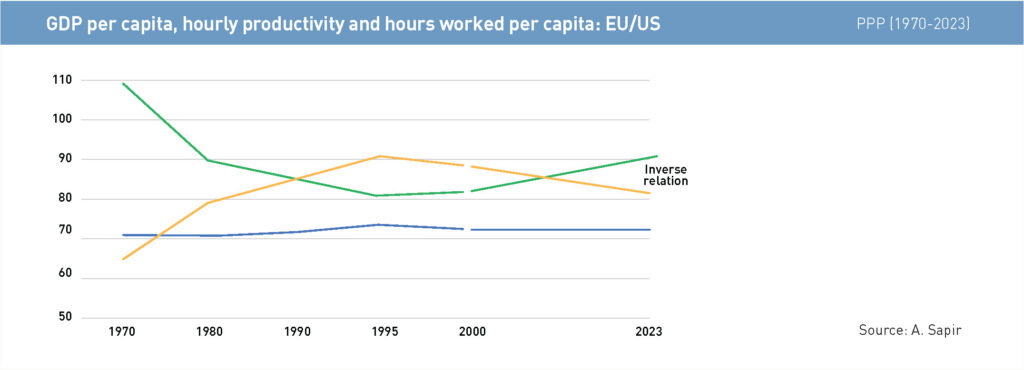
A paradigm shift in EU social policy is needed to move away from the current legislative bias towards a more trust-based policy, including with regard to the role of social partners. The focus should be on ensuring that Europe simultaneously increases employment and productivity and generates the means to finance its social model in a context of demographic ageing. There is a tendency to try to solve every social challenge by proposing new EU legislation instead of focusing on effective implementation and on the development of non-legislative tools. Simplification of EU social legislation can be achieved without diminishing workers' rights. EU efforts to do so are still missing.
Action required - What steps need to be taken in 2026?
- Deliver on the -25% regulatory burden reduction target in the field of social legislation, by preparing a dedicated labour market omnibus to simplify procedures, facilitate compliance and avoid disproportionate obligations and cost. This should include necessary changes to the Pay Transparency Directive, the Transparent and Predictable Working Conditions Directive and the Platform Work Directive, which can be made without reducing the overall level of workers' protection.
- Introduce ambitious simplification measures in the upcoming Fair Labour Mobility Package, including but not limited to digitalisation measures such as a legal proposal on ESSPASS and starting the technical work on the merging of ESSPASS, A1 and eDeclaration.
- Ensure that the upcoming Quality Jobs Act does not undermine simplification efforts of the European Commission by imposing unnecessary additional regulatory burden on employers.
- Finalise the adoption and roll-out of the e-declaration and the revision of the Regulation 883/2004 on the coordination of social security systems, introducing exemptions from prior notification for business trips and short-term postings.
- Earmark at least 50% of European Social Fund resources for skills development and reserve 15% to support skills development resources for employers' action.
- Activate the fully functional EU talent pool to facilitate international recruitment in sectors where EU Member States experience shortages.
- Implement the STEM Education Strategic Plan, addressing the talent shortages in STEM by initiating pilot projects inspiring women to pursue STEM careers and attracting international talent.
Graph - GDP per capita, hourly productivity and hours worked per capita: EU/US

Name Goes Here
Position
Your content goes here. Edit or remove this text inline or in the module Content settings. You can also style every aspect of this content in the module Design settings and even apply custom CSS to this text in the module Advanced settings.

Your Title Goes Here
Your content goes here. Edit or remove this text inline or in the module Content settings. You can also style every aspect of this content in the module Design settings and even apply custom CSS to this text in the module Advanced settings.
Your Title Goes Here
Your content goes here. Edit or remove this text inline or in the module Content settings. You can also style every aspect of this content in the module Design settings and even apply custom CSS to this text in the module Advanced settings.
Your Title Goes Here
Your content goes here. Edit or remove this text inline or in the module Content settings. You can also style every aspect of this content in the module Design settings and even apply custom CSS to this text in the module Advanced settings.
Your content goes here. Edit or remove this text inline or in the module Content settings. You can also style every aspect of this content in the module Design settings and even apply custom CSS to this text in the module Advanced settings.
Your content goes here. Edit or remove this text inline or in the module Content settings. You can also style every aspect of this content in the module Design settings and even apply custom CSS to this text in the module Advanced settings.
Your Title Goes Here
Your content goes here. Edit or remove this text inline or in the module Content settings. You can also style every aspect of this content in the module Design settings and even apply custom CSS to this text in the module Advanced settings.
Your Title Goes Here
Your content goes here. Edit or remove this text inline or in the module Content settings. You can also style every aspect of this content in the module Design settings and even apply custom CSS to this text in the module Advanced settings.
Your Title Goes Here
Your content goes here. Edit or remove this text inline or in the module Content settings. You can also style every aspect of this content in the module Design settings and even apply custom CSS to this text in the module Advanced settings.
Your Title Goes Here
Your content goes here. Edit or remove this text inline or in the module Content settings. You can also style every aspect of this content in the module Design settings and even apply custom CSS to this text in the module Advanced settings.
Your Title Goes Here
Your content goes here. Edit or remove this text inline or in the module Content settings. You can also style every aspect of this content in the module Design settings and even apply custom CSS to this text in the module Advanced settings.

This is a test text block
This is a test text block
Your content goes here. Edit or remove this text inline or in the module Content settings. You can also style every aspect of this content in the module Design settings and even apply custom CSS to this text in the module Advanced settings.
Your content goes here. Edit or remove this text inline or in the module Content settings. You can also style every aspect of this content in the module Design settings and even apply custom CSS to this text in the module Advanced settings.
Your content goes here. Edit or remove this text inline or in the module Content settings. You can also style every aspect of this content in the module Design settings and even apply custom CSS to this text in the module Advanced settings.

Your content goes here. Edit or remove this text inline or in the module Content settings. You can also style every aspect of this content in the module Design settings and even apply custom CSS to this text in the module Advanced settings.
Your Title Goes Here
Your content goes here. Edit or remove this text inline or in the module Content settings. You can also style every aspect of this content in the module Design settings and even apply custom CSS to this text in the module Advanced settings.
Your Title Goes Here
- Your Title Goes Here 87%
- Your Title Goes Here 50%
- Your Title Goes Here 100%


This is a test text block
This is a test text block