
BusinessEurope expectations for COP31
Documents
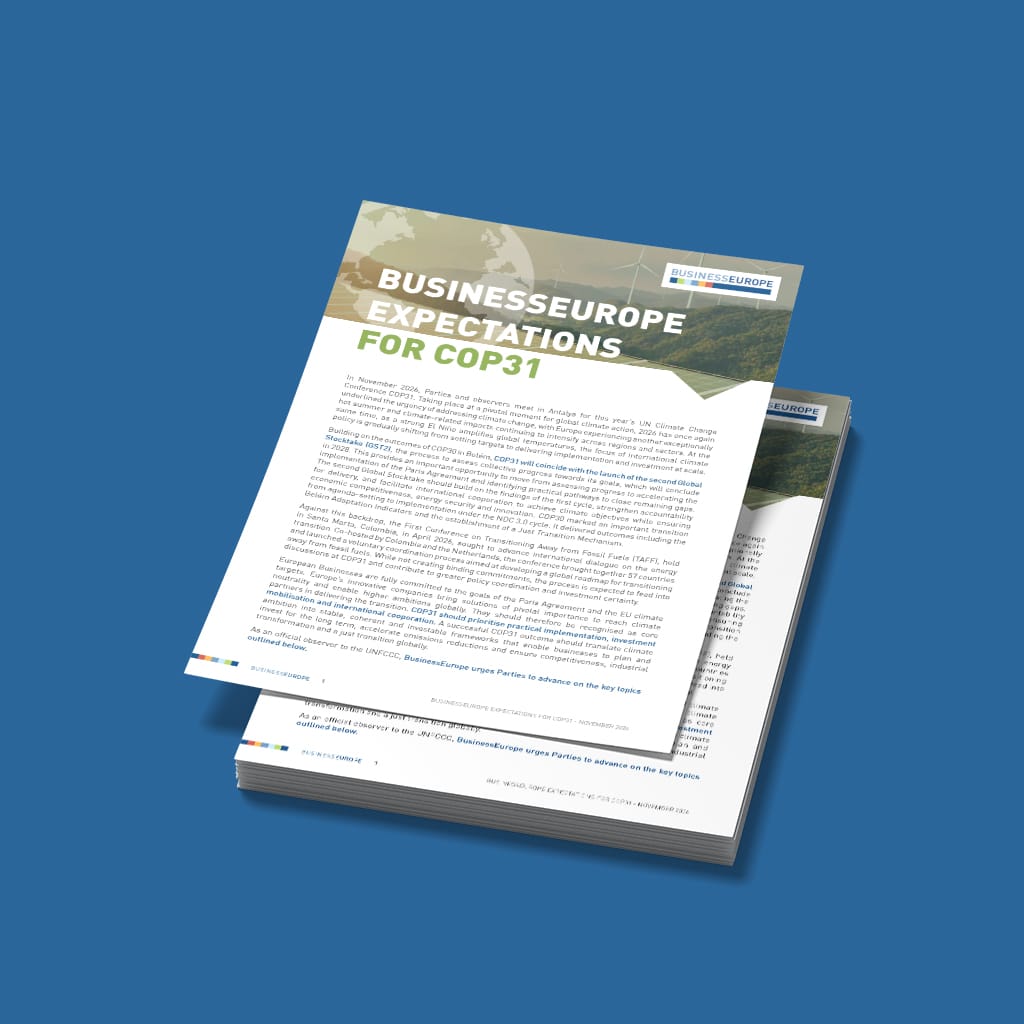
In November 2026, Parties and observers meet in Antalya for this year’s UN Climate Change Conference COP31. Taking place at a pivotal moment for global climate action, 2026 has once again underlined the urgency of addressing climate change, with Europe experiencing another exceptionally hot summer and climate-related impacts continuing to intensify across regions and sectors. At the same time, as a strong El Niño amplifies global temperatures, the focus of international climate policy is gradually shifting from setting targets to delivering implementation and investment at scale.
Building on the outcomes of COP30 in Belém, COP31 will coincide with the launch of the second Global Stocktake (GST2), the process to assess collective progress towards its goals, which will conclude in 2028. This provides an important opportunity to move from assessing progress to accelerating the implementation of the Paris Agreement and identifying practical pathways to close remaining gaps. The second Global Stocktake should build on the findings of the first cycle, strengthen accountability for delivery, and facilitate international cooperation to achieve climate objectives while ensuring economic competitiveness, energy security and innovation. COP30 marked an important transition from agenda-setting to implementation under the NDC 3.0 cycle. It delivered outcomes including the Belém Adaptation Indicators and the establishment of a Just Transition Mechanism.
Against this backdrop, the First Conference on Transitioning Away from Fossil Fuels (TAFF), held in Santa Marta, Colombia, in April 2026, sought to advance international dialogue on the energy transition. Co-hosted by Colombia and the Netherlands, the conference brought together 57 countries and launched a voluntary coordination process aimed at developing a global roadmap for transitioning away from fossil fuels. While not creating binding commitments, the process is expected to feed into discussions at COP31 and contribute to greater policy coordination and investment certainty.
European Businesses are fully committed to the goals of the Paris Agreement and the EU climate targets. Europe’s innovative companies bring solutions of pivotal importance to reach climate neutrality and enable higher ambitions globally. They should therefore be recognised as core partners in delivering the transition. COP31 should prioritise practical implementation, investment mobilisation and international cooperation. A successful COP31 outcome should translate climate ambition into stable, coherent and investable frameworks that enable businesses to plan and invest for the long term, accelerate emissions reductions and ensure competitiveness, industrial transformation and a just transition globally.
As an official observer to the UNFCCC, BusinessEurope urges Parties to advance on the key topics outlined in this paper.