
Benchmarking competitiveness checks used in selected EU impact assessments from 2025-2026 – a BusinessEurope position paper
Documents
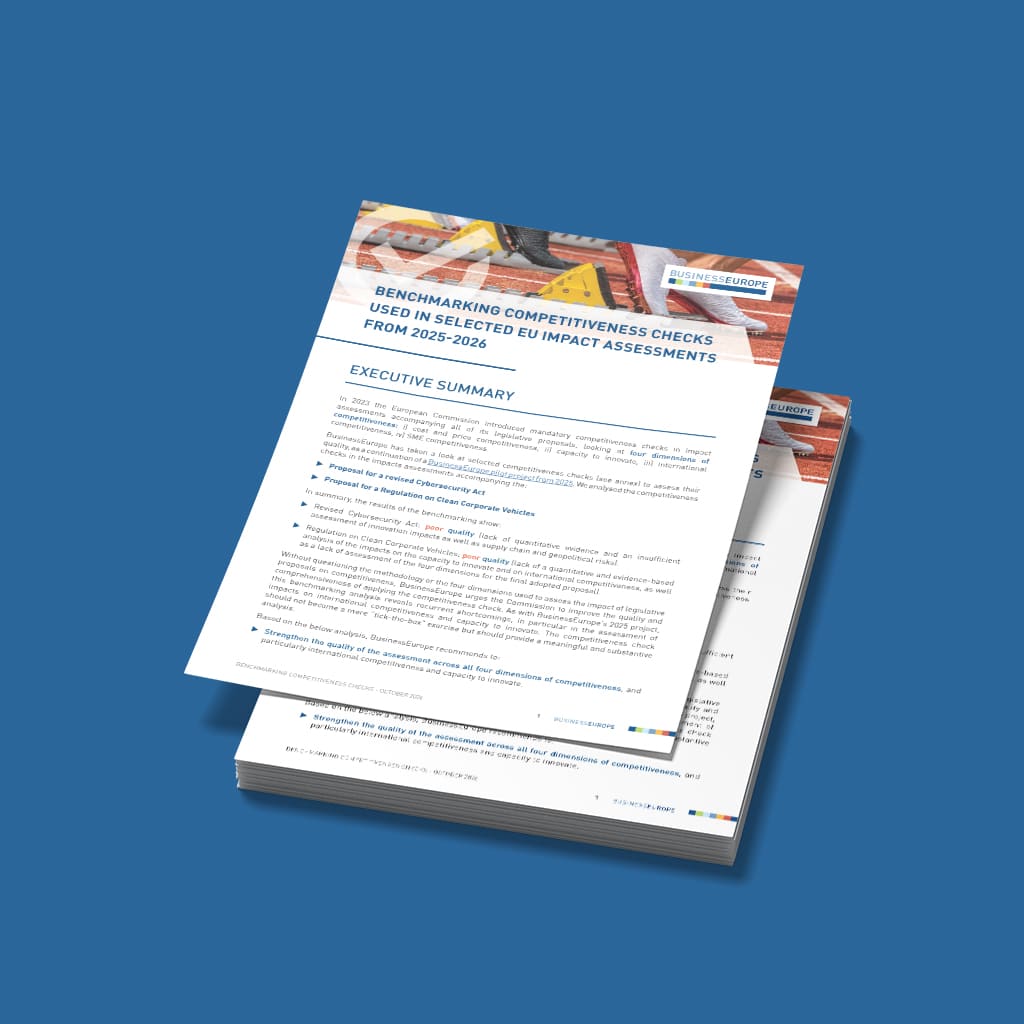
Executive summary
In 2023 the European Commission introduced mandatory competitiveness checks in impact assessments accompanying all of its legislative proposals, looking at four dimensions of competitiveness: i) cost and price competitiveness, ii) capacity to innovate, iii) international competitiveness, iv) SME competitiveness.
BusinessEurope has taken a look at selected competitiveness checks (see annex) to assess their quality, as a continuation of a BusinessEurope pilot project from 2025. We analysed the competitiveness checks in the impacts assessments accompanying the:
- Proposal for a revised Cybersecurity Act
- Proposal for a Regulation on Clean Corporate Vehicles
In summary, the results of the benchmarking show:
- Revised Cybersecurity Act: poor quality (lack of quantitative evidence and an insufficient assessment of innovation impacts as well as supply chain and geopolitical risks).
- Regulation on Clean Corporate Vehicles: poor quality (lack of a quantitative and evidence-based analysis of the impacts on the capacity to innovate and on international competitiveness, as well as a lack of assessment of the four dimensions for the final adopted proposal).
Without questioning the methodology or the four dimensions used to assess the impact of legislative proposals on competitiveness, BusinessEurope urges the Commission to improve the quality and comprehensiveness of applying the competitiveness check. As with BusinessEurope’s 2025 project, this benchmarking analysis reveals recurrent shortcomings, in particular in the assessment of impacts on international competitiveness and capacity to innovate. The competitiveness check should not become a mere “tick-the-box” exercise but should provide a meaningful and substantive analysis.
Based on the below analysis, BusinessEurope recommends to:
- Strengthen the quality of the assessment across all four dimensions of competitiveness, and particularly international competitiveness and capacity to innovate.
- Provide a more robust, quantitative and evidence-based assessment of expected costs and benefits, including compliance and implementation costs across the supply and value chain, investment needs, impact on R&D expenditure and innovation.
- Reinforce the evidence base through strengthened stakeholder engagement during the entire phase of conducting competitiveness checks.
- Establish at least potential links between competitiveness impacts of the analysed policy intervention in question and related existing regulatory frameworks to avoid cumulative impacts.
- Ensure consistency between the competitiveness check conclusions and the political priorities of competitiveness and regulatory simplification in the final legislative proposal.